The Invention of the Time Capsule
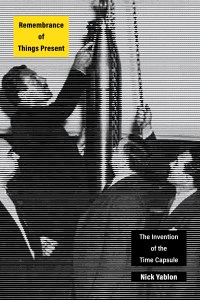
Published by University of Chicago Press (2019)
Time capsules may seem trivial and useless to historians, but, as Nick Yablon shows in this new book, they offer crucial insights into how people view their own time, place, and culture, and their duties to future generations. Remembrance of Things Present traces the birth of the time capsule to the Gilded Age, when the growing volatility of cities prompted doubts about how, if at all, the period would be remembered. Yablon details how Americans from all walks of life constructed prospective memories of their present by contributing not just written testimony but also sources that professional historians and archivists still considered illegitimate, such as material artifacts, photographs, phonograph records, and films. By offering a direct line to posterity, time capsules also stimulated various hopes for the future. Remembrance of Things Present delves into these treasure chests to unearth those forgotten futures.
Blurbs
“Remembrance of Things Present is a landmark work of cultural history that brings sophisticated theoretical insights about modernity, temporality, and politics to bear upon the history of a unique timekeeping innovation: the time capsule. Yablon brilliantly identifies ‘a crisis of posterity’ that left Americans moored in the islands of the present but longing for bridges to the future. In clear and compelling prose, he insightfully explores how time capsules emerged in response to temporal displacement, democratizing politics, and what we today call information overload. This is a book of many dimensions, artfully executed, original, and rewarding, especially for scholars of modernity, temporality, and memory.” ― Alexis McCrossen, author of Marking Modern Times
“Remembrance of Things Present explains how anxieties about nation-building, prophecies, historic preservation, and a certain ‘duty to posterity’ led to the making, and sealing, of dozens of time capsules intended to tell the future about the past. This book is a fascinating study of the faith placed in physical objects as a pledge to tomorrow.” ― Erika Doss, author of Memorial Mania
“In this brilliant book, Yablon unearths many buried treasures. Like the very best in the business, he is a three-tool historian: he can dig, he can think, and he can write. The packages left by his colorful cast of characters contain every major issue in American history after 1865. Time vessels—part tomb and part womb—also show us something deep about media that strive to bridge the gaps of time, space, and meaning.” ― John Durham Peters, author of The Marvelous Clouds
“Yablon has produced a fascinating and learned account of how earlier generations of Americans thought about time. His survey of the practice of packaging objects and texts in order to project them into the future and rescue the present from oblivion manages to provide both a coherent narrative of cultural change from the Gilded Age through the Great Depression and a moving meditation on such subjects as historical self-consciousness, technological utopianism, mortality, and the number 100. Remembrance of Things Present is one of the most gratifying scholarly studies of US cultural history I’ve read in years. And at a moment when technological acceleration and climate change undermine confident imaginings of the future, this book will strike even nonspecialists as, well, timely.” ― David M. Henkin, author of The Postal Age
“Yablon takes readers on a wild ride that offers new insights into how late nineteenth- and twentieth-century Americans understood historical memory and their own ephemeral place in history. . . . The depth of his research, the fearlessness with which he pursues leads, and the heft of the questions he asks along the way offer historians rare opportunities to dissect history making in motion.” ― The Annals of Iowa
“What is cultural memory, and how do we preserve it? These questions are near and dear to an archivist’s heart, and also central themes of Nick Yablon’s book. By tracing the history of the time capsule, Yablon explores our hopes of documenting the present and thus communicating with the future. From the Library’s Modern Historic Records Association files, Yablon explores how an early 20th century organization attempted to document lives “writ on water” and, in so doing, grappled with the question of what was worth saving without the perspective of historical hindsight.” ― New York Public Library
“Deeply researched, deftly structured, and conceptually inventive, Remembrance of Things Present shows that what has been buried in recent decades is not the present, but the concept of the future.” — Justin T. Clark ― Reviews in American History.
Table of contents
Introduction: Memory, History, Posterity
1 Safeguarding the Nation: Photographic Offerings to the Bicentennial, 1876–1889
2 “P.O. Box to the Future”: Temperance, Insurgence, and Memory in San Francisco, 1879
3 Annals of the Present, the Local, and the Everyday: The Centurial Time Vessels as Heterodox History, 1900–1901
4 Seeds of Hope: “Posteritism” and the Political Uses of the Future, 1900–1901
5 “A Living History of the Times”: The Modern Historic Records Association, 1911–1914
6 Mausoleums of Civilization: Techno-Corporate Appropriations of the Time Vessel, 1925–1940
7 Breaking the Seal: The Vicissitudes of Transtemporal Communication
Epilogue: The Time Capsule’s Futures
 nick yablon